
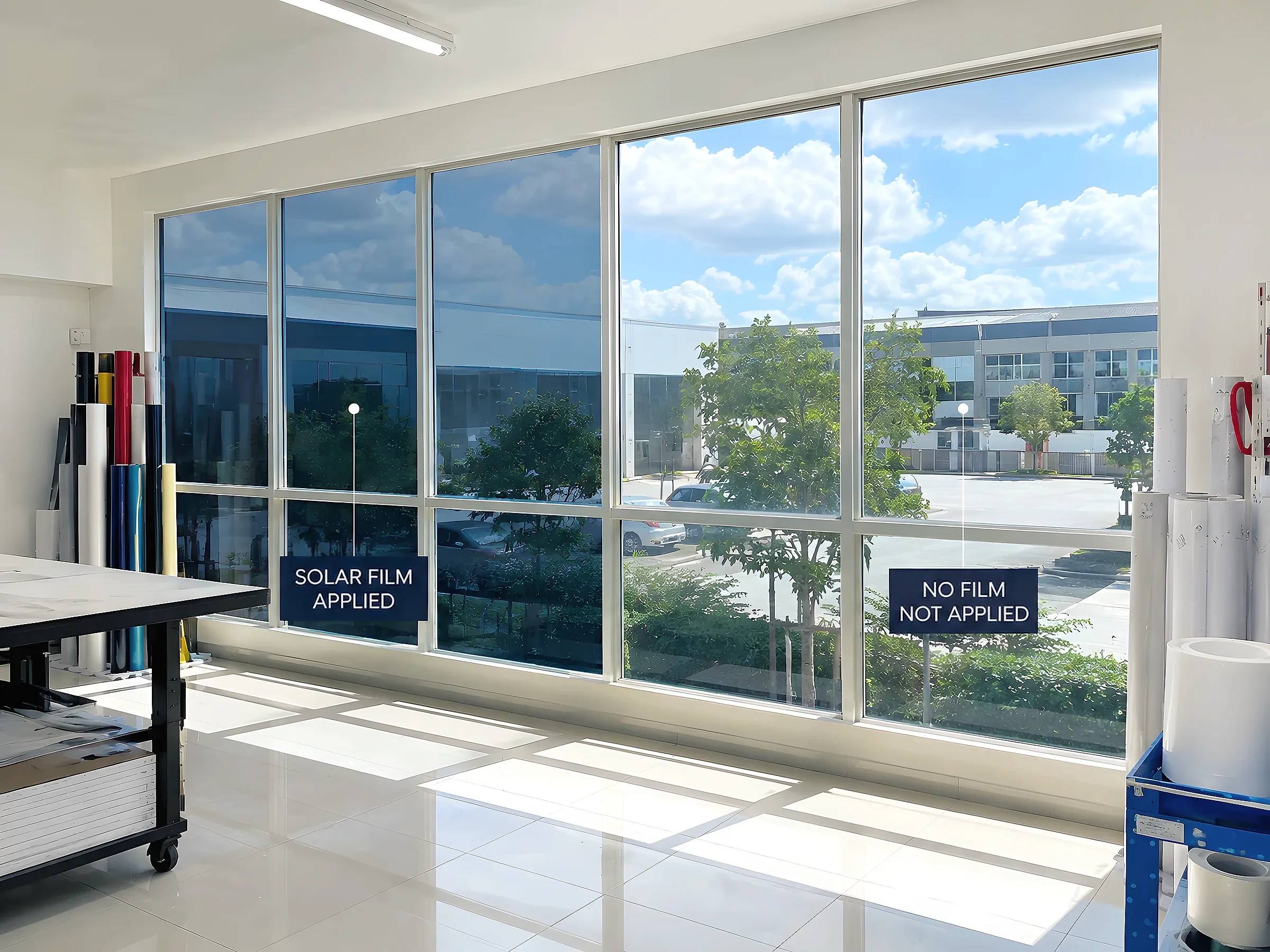
A filter added to an existing glazing system
Solar control film is a thin laminate applied to glass to change how solar energy passes through it. Depending on its construction, the film can absorb part of that energy, reflect part of it, and allow the remainder into the room. It can also reduce visible brightness and limit the passage of ultraviolet light.
Those effects are related but not identical. A dark-looking film is not automatically the strongest performer for heat control, and a nearly clear film can still be designed to manage selected wavelengths. The useful question is not simply how tinted the glass will look. It is which part of the solar spectrum the film is intended to influence, and how that choice fits the room.
Film works as part of the complete window assembly. Glass type, pane construction, coatings, orientation and shading all affect the final behaviour. A film specification should therefore be considered against the existing glazing rather than as an isolated sheet of material.
Solar gain and the feeling of heat
Sunlight carries energy through a window. Interior surfaces absorb some of that energy and warm up, then release heat into the room. Solar control film reduces the portion entering by reflecting or absorbing it according to the film design.
Reflective films send more energy back toward the exterior. Absorbing films take energy into the glass and film, where some of it is released to either side. This distinction matters because extra absorption changes the thermal load within the pane. Compatibility with the glass assembly is important, particularly where panes are coated, laminated, toughened or part of an insulated unit.
Film can reduce solar heat gain, but it is not an air-conditioning system and does not prevent every source of heat. Warm outdoor air, uninsulated walls, equipment, lighting and occupancy still influence the room. The effect will also vary through the day as the angle of the sun changes.
Glare is about visible contrast
Glare happens when a bright view or reflection sits beside a much darker working area. Screens become difficult to read, eyes repeatedly adjust, and direct sunlight can dominate the room. A film that lowers visible light transmission can soften that contrast.
The amount of tint needs judgement. Heavy glare control can make the interior calmer in strong sun but may also make the room feel dim in overcast conditions. It changes the view from both sides and can create a more reflective appearance when one side of the glass is much brighter than the other.
Glare control is often orientation-specific. A window facing low morning or evening sun behaves differently from one receiving diffuse daylight. External shading, blinds and the position of desks can work with film rather than being treated as competing solutions.
Ultraviolet light and fading
Many solar films are designed to reduce the ultraviolet component that passes through glass. Ultraviolet exposure contributes to fading and material degradation, so limiting it can be useful around furnishings, display items and interior finishes.
It does not make the interior immune to fading. Visible light, heat, the sensitivity of dyes and materials, and the duration of exposure all play a part. Film can reduce one important contributor without removing every cause. Claims about protection should be read as part of the complete product data rather than interpreted as an absolute shield.
Ultraviolet control is also separate from privacy. A film may filter ultraviolet light while remaining visually clear. Conversely, a strongly mirrored appearance does not mean the view will be private under every lighting condition.
What film cannot promise
Daytime reflective film relies on a difference in light levels. When the exterior is brighter, the outside face can look more reflective. At night, with lights on indoors, that balance reverses and people outside may see in. Curtains, blinds or another privacy measure are still needed where reliable night-time screening matters.
Film does not repair cracked glass, failed seals or moisture trapped inside an insulated unit. It cannot correct poor ventilation, and it should not be used to disguise a glazing defect. Nor does it turn ordinary glass into safety glazing unless the complete tested system is specifically designed and documented for that purpose.
The practical value of solar control film is precise: it changes the transmission, absorption and reflection of energy through compatible glass. Its usefulness comes from matching those properties to the window, the direction of the sun and the way the room is used.
Viking Signrite lists solar control window films under Solar Films.